With International Dot Day coming up this week I thought it might be fun for students to experiment with color and 3 different media choices.
Years ago a parent gave me a large collection of buttons that I still have not exhausted, even though I have used them to start several art projects. I thought they could be the starting dot.
To introduce the stripes, David Shannon's A Bad Case of Stripes provides the perfect springboard to discuss color theory (whatever aspect is appropriate to the grade level, i.e. warm/cool, complementary, primary/secondary/tertiary, tints/shades, etc.). This book also is about not letting others influence your choices and being true to yourself, also a nice trait to relate to art.
The project is for each student to start with a 6" X 6" board (or paper) with a button "dot" glued near the center. The student then makes concentric circle stripes around the dot using one of 3 media: watercolor marker painted over with clear water, water soluble wax pastels colored pencils painted over with water, or plain watercolor. Of course, you could use whatever media you like. I chose these because they allowed me to teach primary students how to use a paintbrush correctly with attention to direction of line when using it. Lessons here, and here. I like for kids to experiment to find colors they like to have next to each other.
Watercolor Marker (Crayola) painted over with water.
Water soluble Wax Pastels painted over with water.
Pan Watercolors
For this version I like to require students to use the lid of
their pan to mix new colors to use.
Just imagine a whole bulletin board of these displayed as a collaborative work!!!! Happy Dot Day everyone (this Friday)!
Showing posts with label Little Things. Show all posts
Sunday, September 10, 2017
Thursday, June 4, 2015
Art and Math Everywhere!!!
Two weeks ago, when kindergarteners started creating their buildings for a collaborative EXTRAVAGANZA to be revealed in August when school starts up again, I thought the focus was going to be the use of Color, at least that's what my lesson plan indicated.
Well, I was only half right -- read on . . .
I started with a Smartboard presentation on "crooked and colorful buildings in the world" with a focus on the art of James Rizzi and the architecture of our local star, Frank Gehry. In 1978, Gehry remodeled his family home experimenting with some building materials that were pretty unusual at the time. He, of course, has gone on to design some spectacular buildings that seem to soar into the space around them with anything but perpendicular walls! Since his house is walking distance from our school, it seemed that a look at some of his buildings around the world would be a good place to start our classroom discussion.
Then our art began. Kindergarteners spent Day One painting buildings a variety of colors using cake tempera. First, I modeled how to paint using the broad side of the brush to get fatter lines AND how to paint all in one direction.
Then we switched to liquid tempera to paint the windows. I demonstrated how you can let the brush do the work of painting the squares and rectangles by just pressing and painting a short stroke. Students also tried to paint their windows in straight rows to indicate floors in a building.
We let these buildings dry.
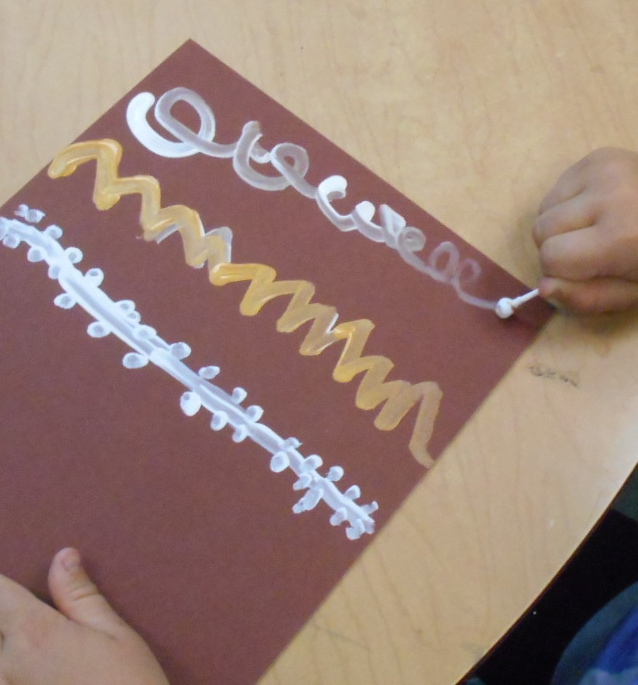
On Day 2, using white and GOLD tempera and Q-tips instead of brushes, kids made a background using line designs that we had learned about three weeks before.
As I said, I am saving all of these "crooked creations" for a giant crooked city display in the Auditorium for when school starts in August. Be sure to check back for the big reveal!! AND . . . have a glorious and rejuvenating summer!!!
By the way, I first did this lesson with 5th graders a number of years ago with a bit more emphasis on design details on buildings and use of complementary colors. You can find that lesson HERE.
Well, I was only half right -- read on . . .
I started with a Smartboard presentation on "crooked and colorful buildings in the world" with a focus on the art of James Rizzi and the architecture of our local star, Frank Gehry. In 1978, Gehry remodeled his family home experimenting with some building materials that were pretty unusual at the time. He, of course, has gone on to design some spectacular buildings that seem to soar into the space around them with anything but perpendicular walls! Since his house is walking distance from our school, it seemed that a look at some of his buildings around the world would be a good place to start our classroom discussion.
Then our art began. Kindergarteners spent Day One painting buildings a variety of colors using cake tempera. First, I modeled how to paint using the broad side of the brush to get fatter lines AND how to paint all in one direction.
Then we switched to liquid tempera to paint the windows. I demonstrated how you can let the brush do the work of painting the squares and rectangles by just pressing and painting a short stroke. Students also tried to paint their windows in straight rows to indicate floors in a building.
We let these buildings dry.
On Day 2, using white and GOLD tempera and Q-tips instead of brushes, kids made a background using line designs that we had learned about three weeks before.
While the paint was drying a bit, kids outlined their windows and doors with a Sharpie. And this is where the MATH popped up and took over. One little boy started counting his windows as I walked by. I stopped to watch and talk to him about this (he had 24) and the rest of the table got wind of what was going on and started counting. Well, pretty soon everybody was counting.
It would have been fun, time permitting, to have figured out how many windows there were in all, but since time was running out, I posed the question, "Do you think we have more or less than 100 windows in all?" That led to some pretty interesting responses!!
As I said, I am saving all of these "crooked creations" for a giant crooked city display in the Auditorium for when school starts in August. Be sure to check back for the big reveal!! AND . . . have a glorious and rejuvenating summer!!!
By the way, I first did this lesson with 5th graders a number of years ago with a bit more emphasis on design details on buildings and use of complementary colors. You can find that lesson HERE.
Thursday, January 29, 2015
Art in the Hallway
The main hallway in our school leads from the school entry to the office to the cafeteria and then out to the main playground. In other words, it gets LOTS of foot traffic.
This part of our school was built in the late 1930s and all corridors are outdoors (but covered), so when they added these display boards much later, they put glass on them to protect the contents. The lesson for these still lifes can be found here.
I love that kids (as well as parents, teachers, etc) often stop to view and discuss the art. I have often thought, "Wouldn't it be great to have a way to listen in on all the conversation that student art generates?!" I get to hear a little bit of it as I am putting up or taking down displays, but I would so love to capture all the spontaneous comments and share them, too!!!
This part of our school was built in the late 1930s and all corridors are outdoors (but covered), so when they added these display boards much later, they put glass on them to protect the contents. The lesson for these still lifes can be found here.
![]() |
| This recent lesson can be found here. The mat board frames come from the recycle bin of our local frame store (thank you LA Art Exchange for saving us your scraps!!) |
Saturday, November 1, 2014
Glue Dots
First, I must say, as I have said many times before, my favorite all time glue for school projects is Elmer's Glue All. It is nice and thick and the paper doesn't slide around much, as with some other glues. However, the goal is still to use SMALL DOTS of glue.
In prior years when I taught in my own art classroom I had reusable glue cups (portion cups from Smart & Final) and sandwich sticks that students used to scoop a limited amount of glue to make wonderful small dots of glue.
Now that I am working off of an art cart and traveling from room to room, I decided to "bite the bullet" and switch to 4 oz. glue bottles so I wouldn't have to balance 20 wet glue cups as I travelled. The trade off is that now I am battling students' inclination to squeeze rivers of glue from their bottles, making puddles of oozing white glue on their artwork (also fun to transport on a cart)!!
So here is my solution. I TEACH kids to hold the glue bottle horizontally, NOT vertically (good math vocabulary:)) with one hand and we practice 3 steps:
TOUCH the paper,
SQUEEZE GENTLY,
LIFT QUICKLY as soon as they see they dot of glue.
Once I teach the method, we practice on scratch paper -- more than once!!!!!!
Does this work the first time they try it? No.
How about the 2nd time? Maybe.
3rd time? Pretty much.
The result, little dots of glue, and a happy art teacher:))
Of course, I haven't tried this yet with kindergarteners' little hands -- that will be the real test!! I might have to revert to the glue cups after all:))
In prior years when I taught in my own art classroom I had reusable glue cups (portion cups from Smart & Final) and sandwich sticks that students used to scoop a limited amount of glue to make wonderful small dots of glue.
Now that I am working off of an art cart and traveling from room to room, I decided to "bite the bullet" and switch to 4 oz. glue bottles so I wouldn't have to balance 20 wet glue cups as I travelled. The trade off is that now I am battling students' inclination to squeeze rivers of glue from their bottles, making puddles of oozing white glue on their artwork (also fun to transport on a cart)!!
So here is my solution. I TEACH kids to hold the glue bottle horizontally, NOT vertically (good math vocabulary:)) with one hand and we practice 3 steps:
TOUCH the paper,
SQUEEZE GENTLY,
LIFT QUICKLY as soon as they see they dot of glue.
Once I teach the method, we practice on scratch paper -- more than once!!!!!!
Does this work the first time they try it? No.
How about the 2nd time? Maybe.
3rd time? Pretty much.
The result, little dots of glue, and a happy art teacher:))
Of course, I haven't tried this yet with kindergarteners' little hands -- that will be the real test!! I might have to revert to the glue cups after all:))
Tuesday, April 22, 2014
Painted Paper and Math??!!
A couple of weeks ago I ran out of "kid painted paper" for a project we were in the middle of, and with no designated time to have the kids paint more paper I got out some construction paper and started slapping paint on the papers so we'd enough paper to finish our work.
What did I learn during the process??? A LOT!!
Usually when I have kids paint paper I set up each work table with different colors and tools for printing or painting. For example, one table would have forks and warm colors,
another table would have corks or bottle caps, sponges, string, etc.
I almost always have kids go back with 2nd or 3rd colors to add details. Sometimes they change tables with their art to experience new colors or painting materials. All in all, it is a pretty non-directed experience.
Using pre-cut printing cards (I just used scrap mat board) and pose a few questions before kids start printing. Questions like, "How many fours will it take to print the width (or length) of your paper?" or "How many squares will you print on the width (or length) of your paper?" or, a tougher one, "How many squares will you print on your whole paper?" I found myself counting as I printed.
Imagine a whole table of kids quietly counting multiples as they print!!! Well, OK, maybe that is a stretch, but I'll bet I could get a few kids interested in the concept!!
Meanwhile we end up with lots of cool scraps to cut up and use to create even more cool ART!!
Painted papers always make me happy!!!
What did I learn during the process??? A LOT!!
Usually when I have kids paint paper I set up each work table with different colors and tools for printing or painting. For example, one table would have forks and warm colors,
another table would have corks or bottle caps, sponges, string, etc.
Using pre-cut printing cards (I just used scrap mat board) and pose a few questions before kids start printing. Questions like, "How many fours will it take to print the width (or length) of your paper?" or "How many squares will you print on the width (or length) of your paper?" or, a tougher one, "How many squares will you print on your whole paper?" I found myself counting as I printed.
Imagine a whole table of kids quietly counting multiples as they print!!! Well, OK, maybe that is a stretch, but I'll bet I could get a few kids interested in the concept!!
With these you could ask older students, "What is the ratio of dots to squares on this paper?"
| I have come to think it is always good to have some black and white scraps in the mix. |
Painted papers always make me happy!!!
Sunday, September 22, 2013
A Few More Tumbling Cubes
Here are a few more examples of 4th graders work last week. One of my favorite things to do is to post art in the hallway because I get to listen to comments of passers-by. This board is on a main corridor leading to and from the office and the cafeteria, so a lot of kids are using the route as I work. Many discuss with each other the changing art, some stop to chat and discuss the art with me asking how the kids made it, and just about everyone walks on smiling and talking about art.
And here is just a quick note on rulers. It always amazes me how many students can get to 4th grade and still have such a difficult time using a ruler!! For the above art, I asked the classes to use a ruler as a straight edge to draw a border for their work (no measuring involved here -- just holding the ruler flush with the edge of the board and drawing a line -- which I modeled) -- like this:
Nice job!!
The first day I saw more than one student, however, doing this:
Needless to say, on Day 2 I dramatically modeled how NOT to cross over your arms as you try to draw lines!!!!!
Monday, September 9, 2013
Mr. Brush
Blogging often offers such unexpected pleasures. Last year, through this blog, I connected with an art teacher that works not too far from where I am. This past summer I met with her and 5 of her art teacher buddies to share ideas and "talk art." It was such a treat to connect with other art teachers (our small district doesn't have elementary art teachers). As we lamented how many young students show a need for little lessons on the tools of our trade (use and care of brushes, scissors, rulers, etc.) I mentioned how much I love my Mr. Brush poster on brush care. They suggested that I share this on the blog.
A few years ago I read about the Mr. Brush posters offered by Royal Langnickel. I'm not sure where I first heard about them, but it may have been from Phyl's blog, There's a Dragon in My Art Room. They don't list this poster in their catalogue and didn't at that time either. As I recall, I e-mailed them asking if the posters were still available and that I was interested in purchasing them. Lo and behold, I got a very nice response and 2 complimentary posters -- this one on brush care, and another showing all the various types of paintbrushes.
This is my students' favorite. It hangs "front and center" for all to see. A few times last year I neglected to refer to the chart when I was mentioning cleaning the brush in clean water and a bunch of hands shot up in the air to remind me that that was just what Mr. Brush liked!!! I think their favorite picture is the one on the bottom left that says Mr. Brush does not like his hair smashed!!
I was just hanging it up today, getting ready for Wednesday, my first day with students. Yippee -- I am more than ready to get started!! Check back later for our first lesson (a multi-media piece where kids experiment with value, still life, painting and collage).
A few years ago I read about the Mr. Brush posters offered by Royal Langnickel. I'm not sure where I first heard about them, but it may have been from Phyl's blog, There's a Dragon in My Art Room. They don't list this poster in their catalogue and didn't at that time either. As I recall, I e-mailed them asking if the posters were still available and that I was interested in purchasing them. Lo and behold, I got a very nice response and 2 complimentary posters -- this one on brush care, and another showing all the various types of paintbrushes.
This is my students' favorite. It hangs "front and center" for all to see. A few times last year I neglected to refer to the chart when I was mentioning cleaning the brush in clean water and a bunch of hands shot up in the air to remind me that that was just what Mr. Brush liked!!! I think their favorite picture is the one on the bottom left that says Mr. Brush does not like his hair smashed!!
I was just hanging it up today, getting ready for Wednesday, my first day with students. Yippee -- I am more than ready to get started!! Check back later for our first lesson (a multi-media piece where kids experiment with value, still life, painting and collage).
Tuesday, June 18, 2013
Art Room Clean-Up Tips
As art teachers we often have very little time to transition between classes, so clean-up the kids can do themselves is a blessing!! This year, whenever we were using paint or glue, I put out a dampened sponge at each table. Even the youngest of students (kindergarten) delighted in using the sponge to help out. The only warning I gave them was, "Please don't dip the sponge in the dirty paint water -- it already has enough water in it!" At the end of the day I would give all the sponges a quick rinse and they were ready to go for next time.
When we were doing collages or anything that involved cut paper, I put a large size Cool Whip-type container in the center of each work area as the "scrap pile." At the end of each class, a volunteer from the table would empty the scrap bowl into our classroom recycle bin while others at the table gave the floor a quick pick up. Now, that was easy clean up!
Hope everyone is enjoying summer vacation!!!!!!!
When we were doing collages or anything that involved cut paper, I put a large size Cool Whip-type container in the center of each work area as the "scrap pile." At the end of each class, a volunteer from the table would empty the scrap bowl into our classroom recycle bin while others at the table gave the floor a quick pick up. Now, that was easy clean up!
Hope everyone is enjoying summer vacation!!!!!!!
Subscribe to:
Posts (Atom)