Wednesday, March 19, 2014

Shape with Splat the Cat

Rob Scotton's, Splat the Cat, offers many opportunities for primary learning activities. 1st graders explored painting and cutting shapes to create their own version of Splat.

Students started with the basic shapes for their cat -- a large oval with triangle ears. The arms and a tail were options, too.


 Kids used a brush to paint these main shapes, but for all those skinny little hairs, they switched to homemade paper "combs."


The details of eyes, nose, mouth and pink for the ears and paws were done with cut paper and glue, so everyone got a little practice with those basic skills.

For most classes we let our Splats dry and added final touches on a second day.

When the paint was dry, a little pink crayon on the tummies finished off our Splats.


I loved the variety of personalities represented. Somebody thought to add a belly button to this one:
And this little guy with 2 arms up looks ready to spring onto (or after) something!!

Thank you, Rob Scotton, for the delightful stories. And thanks to the photo on Pinterest that directed me to this blog that had the idea. Maybe we'll try Splat's pet mouse Seymour, next!!

Monday, March 10, 2014

Monet Saw Haystacks, We See Menchies

After talking about how artists choose their subjects, 2nd graders had fun making pretend Menchies frozen yogurt sundaes with oil pastels. (Menchies is the yogurt shop across the street from our school.) I did this earlier in the year with 3rd graders and they had such a great time decorating their make-believe sundaes that I had to do the lesson again! The link to that lesson is HERE.

First we looked at Monet's study of light on haystacks at different times of the day and in different seasons, noticing how the light on the haystacks made them look 3 dimensional. I loved the way one little guy raised his hand and asked,  "Wasn't he the guy who painted lilypads in the pond in his garden?" That, of course, led us to a side conversation about Giverny and Monet's fabulous garden! We also took a peek at a few Thiebaud paintings with cylinders to see where the light was coming from for him. Kids got pretty proficient in identifying the direction of the light source directed at cylinders. Last, I used a flashlight shining on a real Menchies cup to solidify the concept.


When we did this lesson with 3rd graders, the folks at Menchies took note and sent us this cool acknowledgement!!

Saturday, March 8, 2014

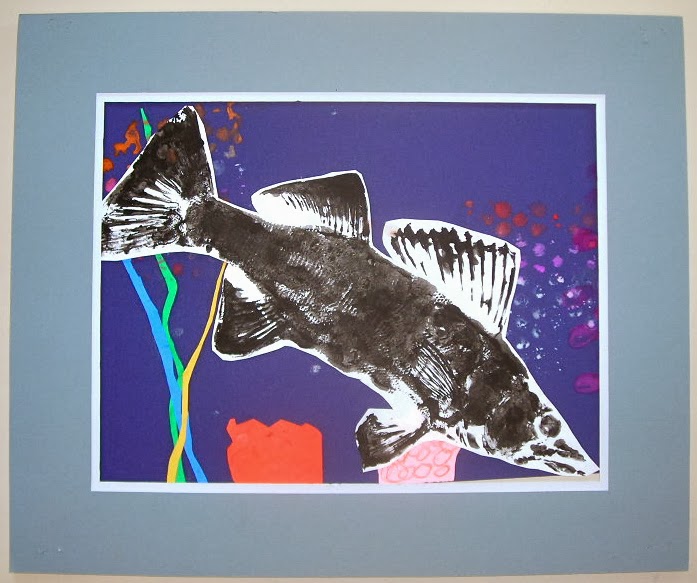
Gyotaku and Bubble Wrap

This past week 2nd graders finished up their month's rotation with me finishing up their Gyotaku. They loved adding the final touches to their underwater collage using bubble wrap to make -- what else -- BUBBLES!!
You have seen this lesson here before. The full lesson is HERE.


Kids used cake tempera in whatever colors they wanted to make their bubbles.
They had pictures of coral, sea grasses and kelp to help them form their collage elements. We discussed currents and how the movement of water would cause light weight grasses move around, too.

 Notice how some fish are angled up or down. We had talked about diagonals as fish were, perhaps, swimming either up or down to go after food!


Sunday, February 23, 2014

Lemons to Lemonade, Paint and Oil Pastels

It won't be long until Kindergarteners will be harvesting their lemon crop!!!

One of our kindergarten classrooms has a FABULOUS lemon tree that is absolutely loaded down with lemons right now. They plan to harvest them and sell lemonade as a fundraiser so there is a sign posted, "Please leave the lemons on our tree" (or something like that!!)

Last week and this week 2nd graders have been creating a multi-media representation of that tree.

They used the above photo enlarged on the Smartboard and oil pastels to draw the tree trunk, shading the dark side and highlighting the side hit by the sun.
This trunk was done with paint. We actually ended up using oil pastel instead.

Next they used wet-on-wet technique for a wash of the sky and ground. This was one of those projects that used a LOT of different media.

The leaves were sponge painted on using regular tempera, again shading the dark side with blue and tinting the light side with yellow.

The last step was make the lemons with oil pastel (again, shading), cut them out and glue them on. I asked kiddos to notice how  many lemons were on the tree and how they overlapped each other frequently. Some remembered this as they glued their lemons.


Thursday, February 13, 2014

Mini-Hearts

Here are a couple of mini-hearts (the short version of the last lesson I posted here) that second graders did in 45 minutes today. They will be headed to our Auditorium as soon as they are dry. Happy Valentine's Day (again)!!

Monday, February 10, 2014

Thinkin' About Hearts for Valentine's Day

I'm thinking about using the cover of Eric Telchin's book, See a Heart Share a Heart as motivation for this heart project for one 2nd grade class this week. This is actually one of those little ideas that started out in my own sketchbook and I was having so much fun doing it that I started thinking about it for the classroom, too (with an added mention of Jim Dine).
The objectives will be centered on warm/cool colors and contrast.

Kids will be using a 9" X 12" illustration board. They'll have a 4" square to define the space for their heart. I'm thinking of having them use pastels for the background so they can have experience rubbing the pastels together for a soft look.

I plan to teach them how to cut out a heart thinking about the numeral "2" as their mental model.
After cutting out their heart, they will use it as a stencil to draw a heart shape inside their square, pressing VERY lightly on the pencil. Then students will draw long ovals to create the shape of the heart.
Next comes the coloring. Using crayons and/or oil pastels, we'll use warm colors to shade the oblong shapes. Some might want to add dimension to their shapes by shading one side of the oblongs darker and then blending the colors.
The last steps will be to outline using black crayon and adding a watercolor resist wash to the square.
                                    Happy Valentine's Day

Wednesday, February 5, 2014

Keith Haring, the Olympics and Mondrian

What do these three entities have in common? Well, last week 5th graders used the positions that Olympic athletes might assume to create a Haring-like figure. They used pipe cleaners and card stock shapes to form a figure showing MOVEMENT.


They quickly drew a contour line around their figure and drew lines to segment that figure into a minimum of 12 sections and cut out the piece.


This drawing was done on white card stock.

I used Mondrian's Compositon A to illustrate how artists think about color BALANCE as they make paintings. For example, Mondrian did not place all his blue shapes in the same area of his painting; he spaced them out. Students then considered that principle of art as they completed the color portion of their art.


Our goal was to create a collaborative "installation" using figures from all 5th graders in the school. Here is part of that work:


As I walked around I noticed that most kiddos were conscientiously considering balance as they chose locations for their colors and patterns/designs. One adult passing the hallway display said I should title the whole board "HAPPY". Not a bad idea as we welcome the Winter Olympics this week!!